

Let’s be honest—every car owner, and frankly, a lot of budget-conscious retailers, have wondered if dedicated car wash soap is just a clever marketing gimmick. After all, soap is soap, right? Why should someone buy a specific automotive chemical when there is a perfectly good bottle of liquid dish soap sitting right by the kitchen sink? It is a fair question, and it leads many to wonder: is car wash soap a waste of money?
For distributors, importers, and retail buyers, understanding the hard science behind this choice is critical. It is the exact boundary line between stocking a stagnant shelf or building a high-margin, repeat-purchase product line.
Let’s look past the marketing hype and look at the chemical reality of whether dedicated automotive formulas actually work.
The Kitchen Sink Confession: Can You Use Dish Soap to Wash a Car?
It is the most common shortcut in DIY car care: grabbing the household dish detergent. To an untrained eye, it seems to work beautifully. It foams up instantly, cuts through stubborn road grime, and leaves the panels looking clean. So, can you use dish soap to wash a car?
Chemically speaking, doing so is a slow disaster for automotive paint.
When analyzing car wash soap vs dish soap, you have to look at what each formula is engineered to target. Dish soap is formulated to be highly aggressive. Its job is to strip away heavy, baked-on animal fats, proteins, and grease from ceramic and metal cookware.
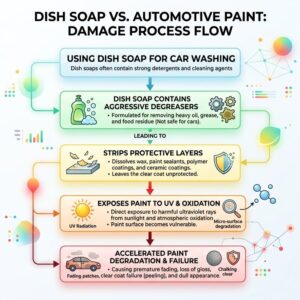
When applied to a vehicle, that same aggressive stripping power goes to work on the exterior surface. It results in stripping automotive wax, polymer sealants, and ceramic coatings right off the vehicle. Without that microscopic barrier, the underlying paint is left completely defenseless against harsh UV rays, road salt, bird droppings, and acid rain.
The Science of the Suds: What Automotive Formulas Do Differently
So, does car shampoo really work? Absolutely—and the proof is found in how the formula behaves at a molecular level. Unlike harsh household detergents, a professional-grade car wash soap is engineered to clean the surface while preserving the vehicle’s underlying defense systems.
1. The Power of a pH-Neutral Formula
While dish soaps often lean toward higher alkalinity to cut food grease, premium car washes maintain a strict pH-neutral formula (around pH 7). This neutral balance ensures that the soap removes loose dirt, dust, and oily road film without chemically reacting with or degrading the waxes, sealants, or delicate rubber trim pieces surrounding the windows.
2. Surfactant Encapsulation
Automotive grime is highly abrasive, consisting of tiny rock particles, industrial fallout, and sharp road debris. Quality car shampoos use a process called surfactant encapsulation.
Instead of just dissolving the dirt, the soap molecules surround individual dirt particles, lifting and isolating them in a slippery chemical bubble. This keeps the abrasive debris suspended inside the foam layer rather than letting it grind directly against the paint.
Micro-Scratches and Matte Finishes: The Cost of Cheap Alternatives
The true cost of trying to save a few pennies with cheap household soap alternatives always surfaces later in the form of paint damage.
When a cleaner lacks proper lubricity and paint scratches occur, it is usually because the wash mitt is dragging trapped dirt across the clear coat. High-grade car shampoos are formulated with specialized glide-agents that maximize lubricity. This creates a slick, microscopic cushion between the washing pad and the vehicle’s body panels.
Without this slickness, every wipe creates thousands of tiny, microscopic swirl marks. Over time, these micro-scratches catch the light, turning a deep, glossy finish into a dull, hazy, matte-like surface.For the vehicle owner, fixing this requires hundreds of dollars in professional paint correction. For a commercial buyer, offering a product that triggers clear-coat degradation is a fast way to lose a customer’s trust for good.
Stocking the Right Product: What Makes the Best Car Shampoo?
If you are an importer, distributor, or private label retailer looking to capture this steady market, you need to know how to identify a formulation that will keep detailing professionals and retail customers coming back.
When vetting bulk formulations for your inventory, look for these key performance indicators to find the best car shampoo for clear coat protection:
- High Lubricity (The “Slickness” Test): The concentrated liquid should feel exceptionally slick between your fingers. Higher lubricity means safer washing and fewer swirl-mark complaints from your end-users.
- Long-Lasting Foam Stability: Thick, dense suds aren’t just for show. High foam stability keeps the cleaning agents active on the vertical panels of the vehicle longer, allowing for better encapsulation before rinsing.
- Clean Sheet Rinsing: The shampoo must rinse away completely with water, leaving zero surfactant film, spotting, or streaks behind on the clear coat or glass.
Final Verdict: A Worthwhile Investment for Vehicle Longevity
Dedicated car wash formulas are not a luxury or a marketing gimmick—they are a chemically necessary shield against paint degradation.
For distributors and B2B buyers, stocking a reliably formulated, protective car shampoo is an easy, highly profitable sell. It directly addresses a costly, real-world problem for your clients. By educating your market on why proper chemical engineering matters, you position your brand as the expert source for vehicle longevity.
Secure Your High-Margin Automotive Line Take control of your inventory with premium, protective car wash formulas engineered for maximum gloss and clear-coat safety. Connect with our private label team today to explore custom pH-neutral formulations, review bulk packaging options, and secure your production run.