
Walk into a high-end restaurant or unbox a freshly washed shipment of retail glassware, and the very last thing a business owner or consumer wants to see is a dull, milky film clinging to the surface.
For bulk buyers and private-label brand owners, encountering persistent dish soap residue is a major operational headache. This common performance issue quickly leads to consumer dissatisfaction and costly product churn. Understanding the chemical roots of this film—and discovering a cloudy glassware fix that works under any regional wash conditions—allows distributors to supply an uncompromised product line that keeps glassware flawless and customer retention high.
Eliminating cloudy film issues and securing high-clarity, export-ready private label detergents begins with a highly sophisticated manufacturing partner; explore our elite contract chemical design capabilities at Boxy Klin.
Mineral Interferences: The Chemistry of Soap Scum Formation
A milky film is rarely just an issue of user error; it is often a fundamental failure of the soap to handle local water chemistry. Regional water profiles interact aggressively with cleaning fluids under the surface.
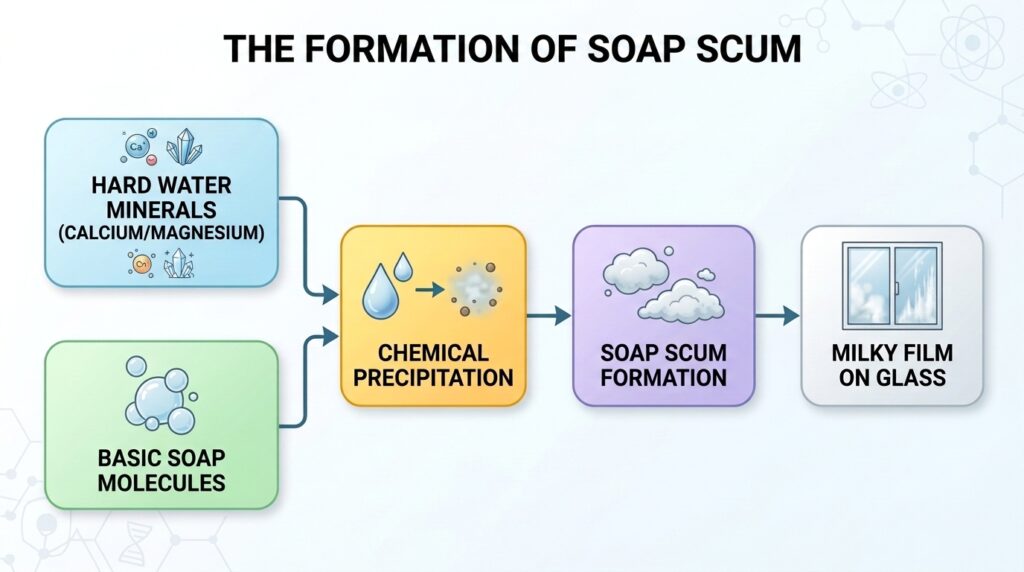
In regions with hard water, high concentrations of hard water minerals (calcium/magnesium) bind aggressively to basic soap molecules. This molecular locking causes a chemical precipitation, resulting in rapid soap scum formation that glues itself onto glass and ceramic surfaces.
To overcome this, a high-performing product must be engineered from the ground up as the best dish soap for hard water. By utilizing advanced chelating agents that isolate and neutralize these minerals, the soap prevents chemical precipitation before it can form a film, maintaining high performance even in environments with elevated TDS (Total Dissolved Solids).
Solubility Metrics: Understanding and Preventing Surfactant Buildup
A stubborn film often stems from surfactant buildup, which happens when heavy synthetic wetting agents fail to dissolve completely during the rinse cycle. The molecular differences between low-grade synthetic cleaners and advanced, clean-rinse formulations are distinct:
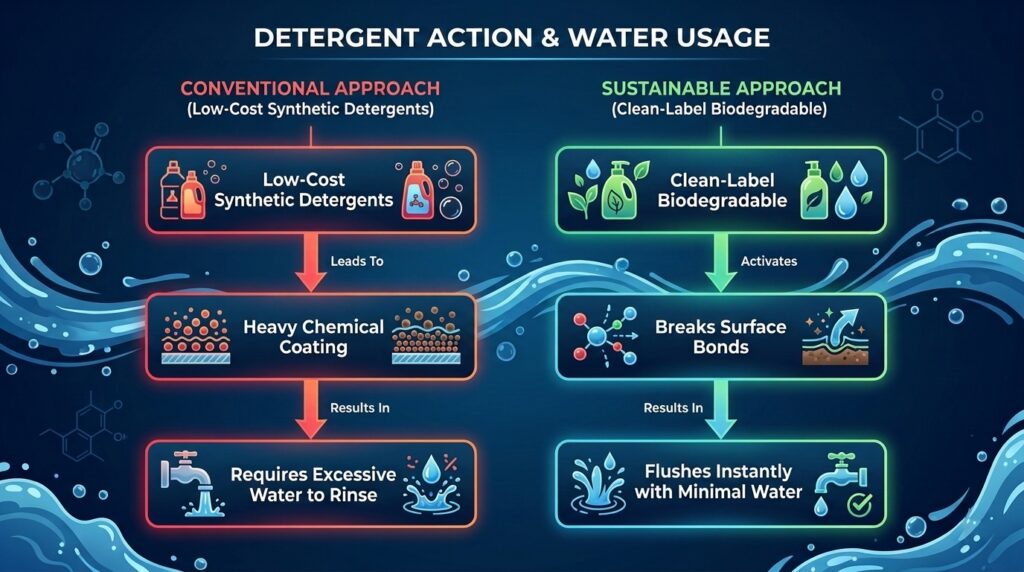
Low-cost, synthetic alternatives often leave a thick chemical coating that requires excessive water to rinse away. In contrast, the choice between biodegradable vs. synthetic detergents heavily favors clean-label, biodegradable elements. These ingredients break their bond with the surface the moment clean water is introduced, ensuring users are rinsing dishes properly without wasting operational water volumes or leaving sticky product deposition behind.
Regional Engineering: Overcoming High TDS Environments
A critical operational challenge for international importers is navigating variable water supplies across different target markets. A high level of TDS (Total Dissolved Solids) in municipal water lines acts as a significant barrier to traditional cleaning liquids.
| Water Quality Profile | Hardness Indicators | Impact on Standard Formulas | Advanced Formulation Fix |
| Low TDS / Soft Water | Minimal mineral ions | High foaming, rapid rinsing | Standard surfactant balance |
| High TDS / Hard Water | High calcium/magnesium | Soap scum formation, dull film | Advanced chelators & stable surfactants |
When a distribution network spans regions with highly variable water qualities, a basic formula will fail in high-TDS zones, leaving heavy streaks. Choosing a product specifically engineered to prevent surfactant buildup guarantees a reliable, clean result across all global water infrastructures. This stability provides a universal how to remove soap film solution that keeps commercial kitchens running smoothly.
To review our complete water-solubility testing profiles, chelating efficiency metrics, and flexible bulk container configurations optimized for international trade, browse our full product catalog at Boxy Klin.
Sourcing Film-Free Inventory for B2B Growth
A dish soap that rinses perfectly clean under any regional condition is a massive asset for building customer loyalty. It offers a powerful business case for international purchasing agents, FMCG brokers, and large retail store chains:
- Minimize Returns: Choosing a private-label line featuring advanced, hard-water-stable chemistry minimizes customer returns and complaints regarding dish soap residue.
- Secure Long-Term Contracts: Providing a reliable, film-free wash experience allows B2B buyers to win high-volume, long-term supply contracts with major restaurant groups, luxury hotel chains, and premium grocery networks.
- Protect Brand Equity: Ensuring an absolute cloudy glassware fix and a definitive answer on how to remove soap film establishes your brand as a tier-one supplier in the institutional care market.
Securing Spotless Global Distribution with Boxy Klin Formulation Mastery
Eliminating persistent dish soap residue requires an advanced understanding of washing chemistry. Overcoming regional hard water minerals (calcium/magnesium) and high TDS (Total Dissolved Solids) levels requires moving away from heavy synthetic chemicals that lead to surfactant buildup and soap scum formation. By choosing a balanced formulation that leverages the solubility differences of biodegradable vs. synthetic detergents, buyers ensure consumers are rinsing dishes properly, delivering an absolute cloudy glassware fix and a definitive guide on how to remove soap film.
At Boxy Klin, we future-proof your private label inventory by manufacturing world-class, high-solubility dishwashing liquids engineered to rinse flawlessly in both soft and high-mineral water environments. Whether you want to introduce an eco-certified consumer retail line that guarantees spot-free glass or secure high-velocity bulk inventory for a regional commercial hospitality network, our West Java manufacturing facility provides complete chemical configuration and end-to-end OEM support.
Connect directly with our international export logistics specialists at Boxy Klin to secure custom formulation samples, review water stability profiles, or request bulk volume manufacturing quotes.