
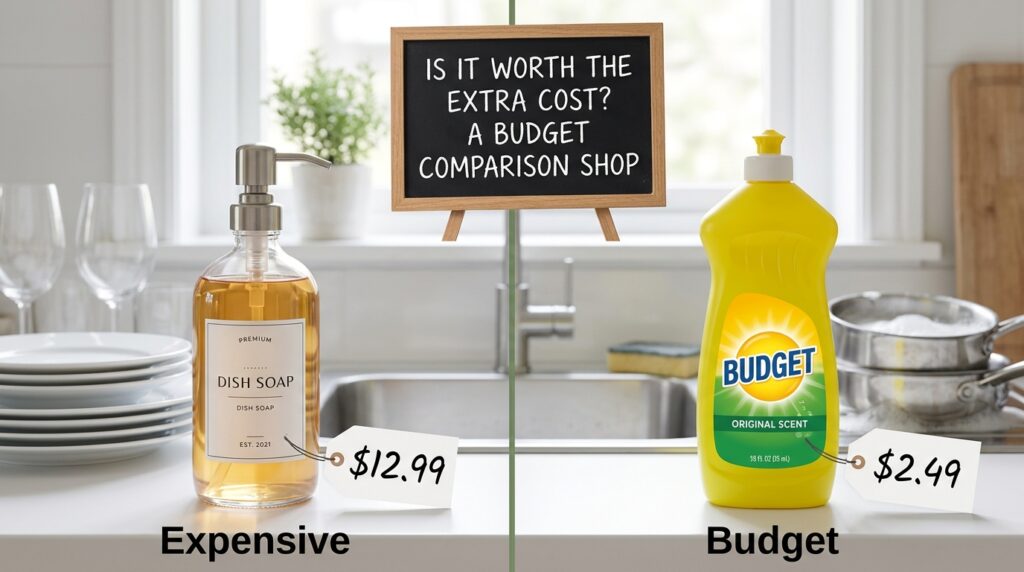
Walk down any wholesale distribution floor or flip through a commercial chemical supplier’s catalog, and the price variance for dishwashing liquids can be staggering. Some premium global brands command double or triple the price of regional, budget-tier offerings.
For procurement officers, hotel food and beverage directors, and consumer goods distributors, this massive gap creates a tough sourcing dilemma. Does expensive dish soap work better, meaning your kitchen staff will wash twice as many plates per load? Or are you simply funding a multinational corporation’s massive consumer marketing budget?
To maximize tight procurement budgets and streamline operations, smart buyers must look past the flashy corporate logo and analyze exactly what is happening to the cleaning chemistry at a molecular level. Navigating the true value of your inventory starts with working with an agile, factory-direct partner; learn about our lean manufacturing philosophy at Boxy Klin.
Formulations Under the Microscope: The Real Cost Drivers
To understand the price performance of cleaning chemicals, you have to decode the relationship between raw material costs and performance output. Liquid soap is fundamentally an emulsion of water, cleaning agents, and stabilizers. How these components are balanced dictates both the wholesale cost and the real-world efficiency.
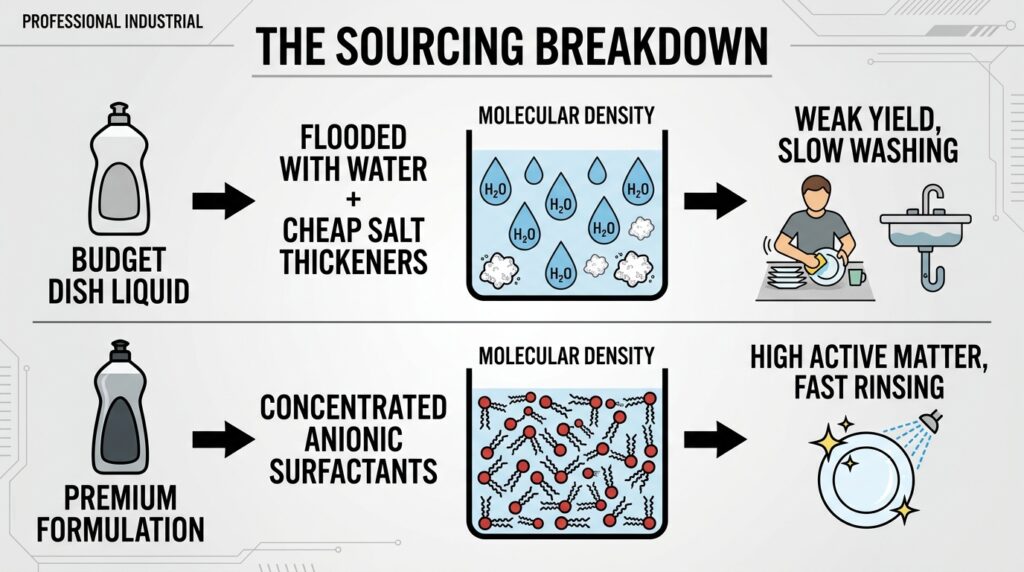
Cheap dish soaps are frequently flooded with water and inexpensive sodium chloride (salt) thickeners. While this combination creates a rich visual texture, the actual cleaning chemistry is weak. Staff must use massive volumes of the chemical to clear a single commercial load.
In contrast, a high-performance formula replaces cheap fillers with an advanced, highly concentrated anionic surfactant blend. These premium surface-active agents cost more upfront because they are engineered to strip oils instantly, even when highly diluted. When analyzing a premium vs budget dish liquid, the upfront price is driven entirely by the active matter percentage—the actual density of dirt-fighting molecules left in the drum once you subtract the water.
Evaluating True Efficiency: How Fast Does It Cut the Fat?
In high-volume commercial cleaning and busy foodservice operations, labor time and water utilities are the highest operational costs. Dismantling the “cheap vs. expensive” argument requires looking closely at the mechanical speed of a wash cycle.
The critical technical metric that matters to an industrial kitchen manager is the lipid solubilization rate—the speed at which the surfactant molecules can break down, encapsulate, and dissolve stubborn animal fats, baked-on proteins, and cooking oils into the water column.
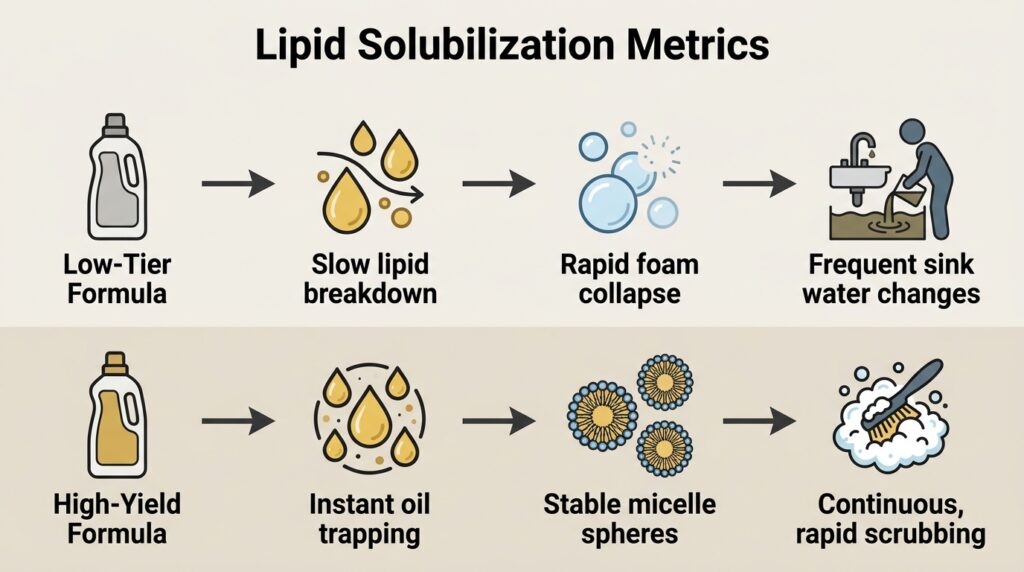
A high yield commercial dish soap achieves instant lipid breakdown. It rapidly forms stable micelle spheres that hold oil in suspension, preventing grease from redepositing onto clean plates or forming a sticky ring around the wash basin.
A cheap, low-active soap forces workers to spend double the time scrubbing individual items and causes the foam blanket to collapse prematurely. This forces staff to drain and refill the basin water constantly, dragging down commercial productivity and driving up utility overhead. When you look at a comprehensive dish soap price performance comparison, a higher-strength formulation significantly reduces total labor hours per shift.
The Visual Illusion of Quality: Thickness vs. Output
One of the easiest traps for a retail procurement officer to fall into is relying on visual textures during product vetting. Many buyers assume that a thick, slow-pouring liquid automatically equals a highly concentrated, premium product.
As established by chemical manufacturers, thickness can easily be faked using inexpensive viscosity modifiers. What business buyers actually need to calculate is the viscosity-to-yield ratio—the relationship between the fluid movement of the soap and the actual volume of usable, high-strength cleaning solution that can be extracted from a single drum of concentrate.
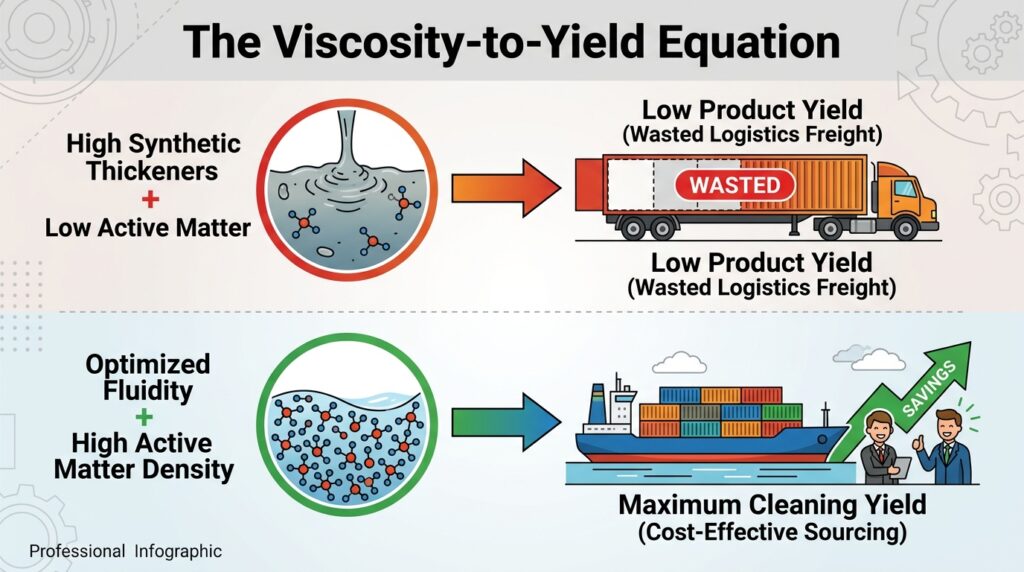
A perfectly balanced, highly concentrated liquid does not require a sludge-like thickness to perform. By engineering a high viscosity-to-yield ratio, an agile manufacturer allows a distributor to ship less useless weight and offer their end-users a massive return on investment (ROI). To look at the laboratory specifications, active material ratios, and performance metrics of our custom-developed formulas, browse our catalog at Boxy Klin.
Defeating Mineral Interference: Performance Across Regional Water Supplies
A major technical variable that bargain-tier soaps completely overlook is regional water quality. In many industrial hubs, coastal commercial facilities, or municipal markets, tap water contains high levels of dissolved calcium and magnesium ions—commonly known as hard water.
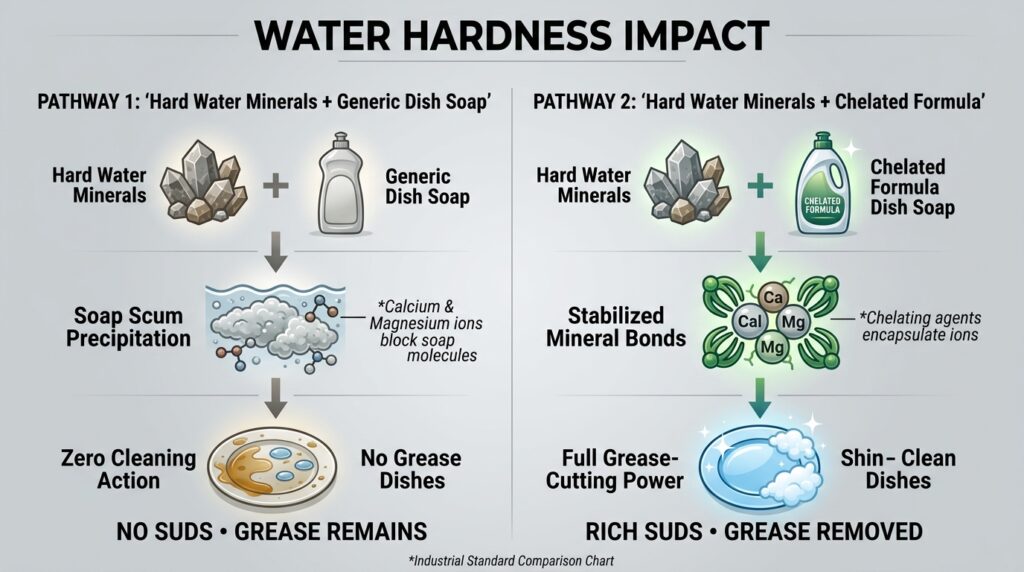
When a standard, low-cost dish liquid hits hard water, the minerals chemically bind with the weak surfactants, causing them to precipitate out as useless soap scum. This strips the soap of its sudsing and grease-cutting capabilities entirely, forcing kitchen staff to triple their usage to get any results.
A sophisticated, cost effective dishwashing chemical incorporates advanced chelating agents and exhibits high water hardness tolerance. These compounds lock up mineral interference before it can compromise the wash cycle, ensuring identical, rapid grease-cutting performance regardless of local water conditions.
Sourcing Smarter for Higher Margins
The objective chemical data confirms that expensive dish soap does not work better simply because of its brand name; it delivers superior performance because it carries a high active matter percentage, an advanced anionic surfactant blend, a high lipid solubilization rate, and excellent water hardness tolerance.
However, paying a massive premium retail brand markup is completely unnecessary for commercial operations.
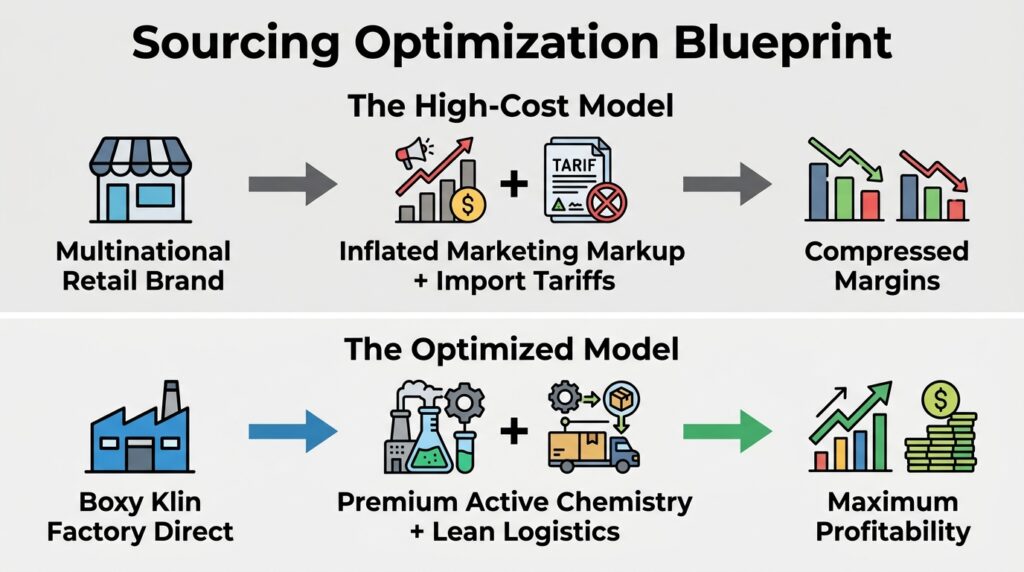
By bypassing the consumer marketing markup and partnering directly with Boxy Klin, distributors, importers, and procurement buyers can secure high-yield, premium formulations tailored to hard water and heavy grease—all at highly competitive, factory-direct wholesale pricing. To request private label manufacturing samples or custom chemical configurations for your specific market, reach out to our team at Boxy Klin.