

Walk into a modern industrial laundry facility or a residential appliance floor today, and the engineering looks radically different than it did a decade ago. Deep-filling, fast-spinning agitator drums are rapidly making way for highly computer-regulated, ultra-lean washing systems designed to slash resource footprint metrics.
Yet, many bulk buyers, institutional laundry facility managers, and chemical procurement officers continue to source the exact same legacy detergent formulas they have used for years. In doing so, they completely overlook a vital question: does your washing machine type affect detergent performance?
When a chemical formulation isn’t perfectly tuned to match the specific physical mechanics of modern laundry hardware, operational efficiency plummets, utilities spike, and fabrics suffer. Aligning your wholesale inventory with the precise mechanical demands of modern laundry technology starts with partnering with an adaptable manufacturer; explore our flexible contract formulation capabilities at Boxy Klin.
The Volumetric Contrast: Sourcing for Traditional vs High Efficiency Washer Systems
Modern laundry hardware completely shifts chemical demands, creating a stark contrast in a traditional vs high efficiency washer comparison. Old-school, traditional top-loading machines operate by completely submerging fabrics in a massive pool of water. They rely on intense mechanical agitation dynamics—a physical central agitator beating the clothing fibers—to push soap through the weave and force dirt out.
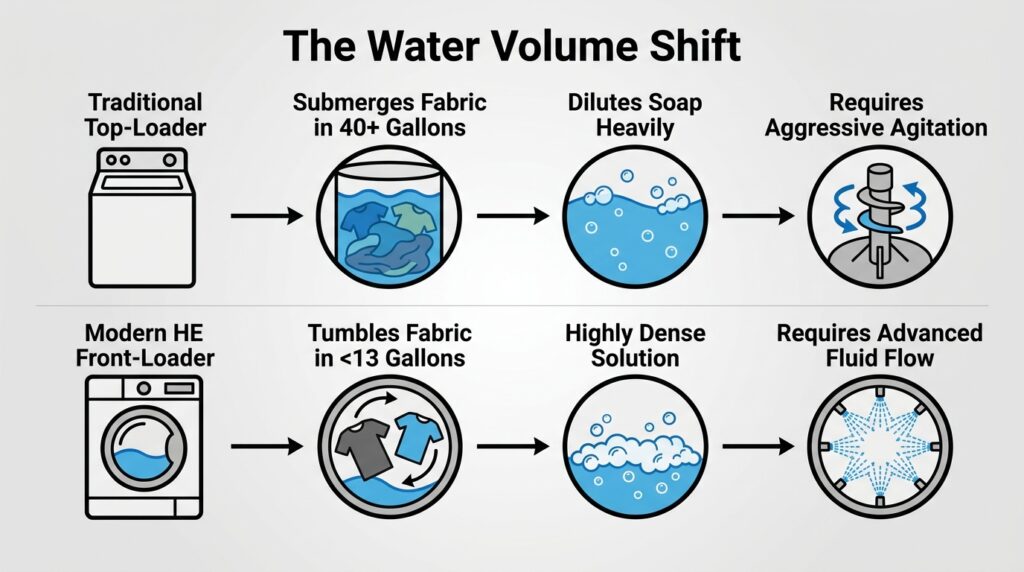
Contrast this with modern front-loaders and high-efficiency (HE) top-loaders. These machines utilize advanced water volume optimization protocols, using up to 70% less water per cycle.
Because there is significantly less water available to dilute the soap, using a standard legacy formula means the chemical density in the drum becomes far too thick and unyielding. This prevents the soap from lifting stains smoothly and alters the laundry detergent difference your customers expect on the wash floor. This variance makes a structured washing machine compatibility guide critical for commercial procurement.
Navigating the Foam Trap: Why Your Fleet Requires Low-Suds Surfactant Technology
Excessive foam creates a massive mechanical headache for facility supervisors and laundry technicians. In an uncalibrated chemical formula, the high-speed tumbling motion of a front-load washer constantly injects air into the lean water pool, rapidly generating a thick, dense blanket of bubbles.
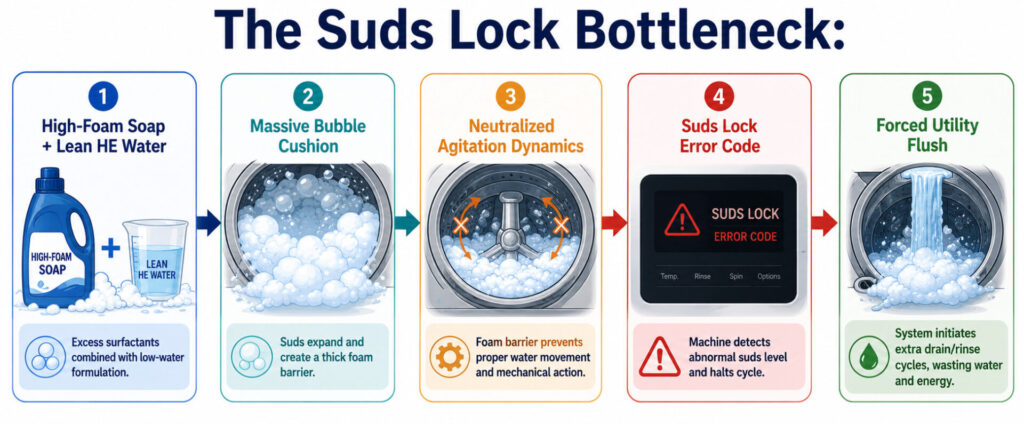
This wall of foam creates severe mechanical consequences. The bubble blanket cushions the fabric as it tumbles, completely neutralizing the machine’s intended drop-and-shatter mechanical action.
Worse, the excess volumetric pressure triggers a costly suds lock error code on digital control panels. When this error trips, the machine is forced to shut down mid-cycle, halt processing, and initiate an unprogrammed drain and flush sequence. This process pumps in extra water to clear the lines, heavily spiking your facility’s ongoing electricity and water utility bills. Sourcing a chemical line built around advanced low-suds surfactant technology is the only way to avoid this operational bottleneck and secure the best detergent for front load washer fleets.
Chemical Stability in Low Water: The Role of Soil Suspension Polymers
Digging deeper into the chemical realities of low-water washing reveals a hidden soil management challenge. In a high-efficiency front-load system, lifted grease, skin oils, and particulate dirt are concentrated into a very small, muddy stream of water rather than being diluted and washed away in a giant tank.
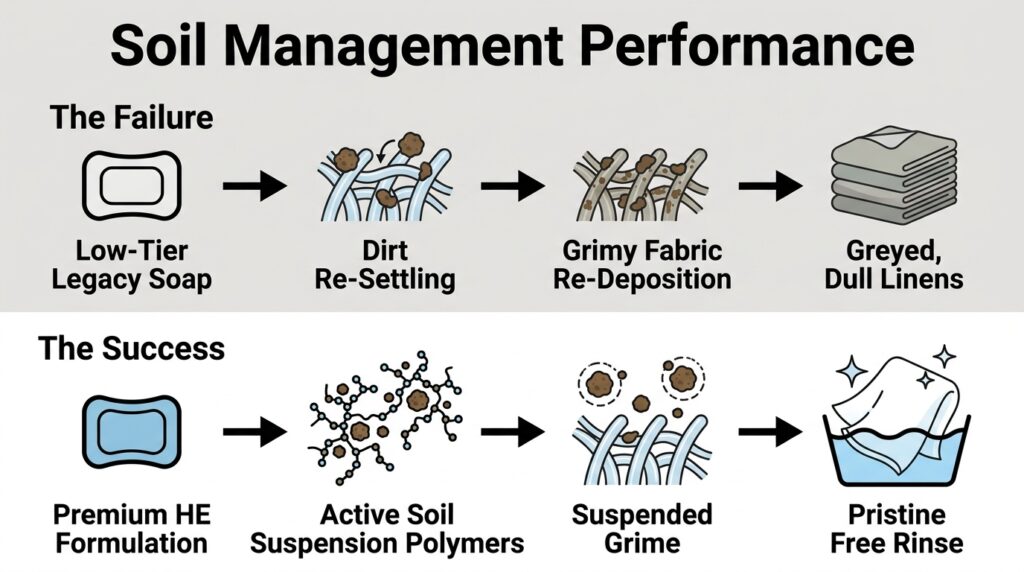
Handling this concentrated stream requires a premium, modern formulation featuring advanced soil suspension polymers. These specialized chemical chains act like microscopic magnets, locking onto lifted grease particles and keeping them floating safely in suspension away from the textiles.
Without these polymers, the floating grime precipitates back down onto the clean fabrics as the drum spins, causing grayed linens, dull whites, and failed quality control standards across your linen inventory.
Future-Proofing the Retail Shelf: The Commercial Value of Universal Compatibility
For B2B distributors, exporters, and retail chain buyers, stocking separate, hyper-specific product lines for different machine styles dilutes your valuable retail shelf space and significantly increases international logistics overheads. The most profitable move is sourcing a universally compatible, highly concentrated detergent.
| Operational Sourcing Advantage | Traditional Detergent Stock | Universal HE Formulation Stock |
| Foam Architecture | Uncontrolled high sudsing bases | Advanced low-suds surfactant technology |
| Water Dispersion | Tailored only for high dilution pools | Optimized for extreme water volume optimization |
| Soil Stabilization | Standard surfactant binding | Infused with high-yield soil suspension polymers |
| Supply Chain Profile | Fragmented SKU management | Streamlined, multi-market universal compliance |
A premium formula that delivers elite, micellar cleaning power in legacy industrial washers while remaining completely safe for sensitive HE digital sensor systems allows distributors to streamline their supply chain. This reduces your global storage footprint and allows your sales teams to pitch a single, bulletproof chemical solution to both commercial laundries and mass-market retail outlets.
Elevating Procurement Standards with Boxy Klin Chemical Engineering
The definitive answer is yes—the physical mechanics of your machinery dictate the success of your soap. Answering whether your washing machine type affects detergent performance requires moving past outdated, high-foaming bases and switching to advanced low-suds surfactant technology backed by heavy soil suspension polymers to eliminate suds lock error code failures and maximize water volume optimization.
At Boxy Klin, we eliminate hardware compliance risks by manufacturing world-class, high-concentration private-label detergents calibrated specifically for modern commercial and high-efficiency washing systems. Whether you are seeking bulk industrial drums for a regional hospitality network or developing a custom-branded retail line for export markets, our West Java manufacturing facility delivers unmatched chemical precision.
Connect directly with our international procurement team at Boxy Klin to secure custom formulation options, request physical samples, verify shipping pathways from our Gunung Putri plant, or arrange ocean freight routing through Tanjung Priok Port.