

If you watch a typical commercial janitorial shift start, you’ll likely see the same costly routine: a maintenance worker wheels out a multi-gallon mop bucket, turns on the tap, and casually glugs floor concentrate directly into the water without ever reaching for a measuring cup or a portioning cap.
For procurement managers, hospitality operations directors, and bulk chemical buyers, this lack of control is a double-edged sword. On one side, it rapidly burns through your chemical inventory budget by exhausting stock months ahead of schedule. On the other side, it floods the ambient air with overpowering chemical fumes that lead to tenant discomfort and brand complaints.
To run a lean, professional facility and protect your bottom line, breaking down the exact mathematical science of a wash bucket is critical. Discovering exactly how much floor cleaner should i use is the simplest way to optimize your operational costs. Standardizing your facility management with precisely engineered, low-waste formulations begins with partnering with an agile manufacturer; discover our smart chemical systems at Boxy Klin.
The Danger of Heavy Dosing: How Excess Chemical Alters Surface Aesthetics
The old-school janitorial mindset assumes that if a little bit of soap cleans well, a massive pour will clean twice as fast. In the world of commercial floor care, this logic leads to a counterintuitive failure. When maintenance crews over-pour product into a bucket, the water becomes oversaturated and cannot dissolve the chemical compounds properly.

This overloaded surfactant load concentration alters how the liquid dries. As the water evaporates, it leaves behind a tacky, microscopic layer of un-rinsed soap active matter.
This sticky layer, or residual film accumulation, acts like a physical magnet for daily foot traffic dust and grease, trapping dirt particles the moment shoes cross the threshold. Over a few weeks, the property ends up suffering from a slow, steady optical clarity degradation. The premium finish of the tiles or polished concrete becomes hazy, streaky, and old, forcing facilities into expensive, premature floor stripping and stripping cycles. Utilizing the correct floor cleaner dosage completely stops this aesthetic decline.
Precision Sourcing: Maximizing Yield with an Efficient Mop Bucket Dilution
To successfully reduce floor chemical waste across a multi-site operation, procurement officers must mandate a strict standard for fluid portioning. High-quality commercial floor concentrates are chemically engineered to perform flawlessly at incredibly lean dilution rates, far removed from the weak formulas found on retail grocery shelves.
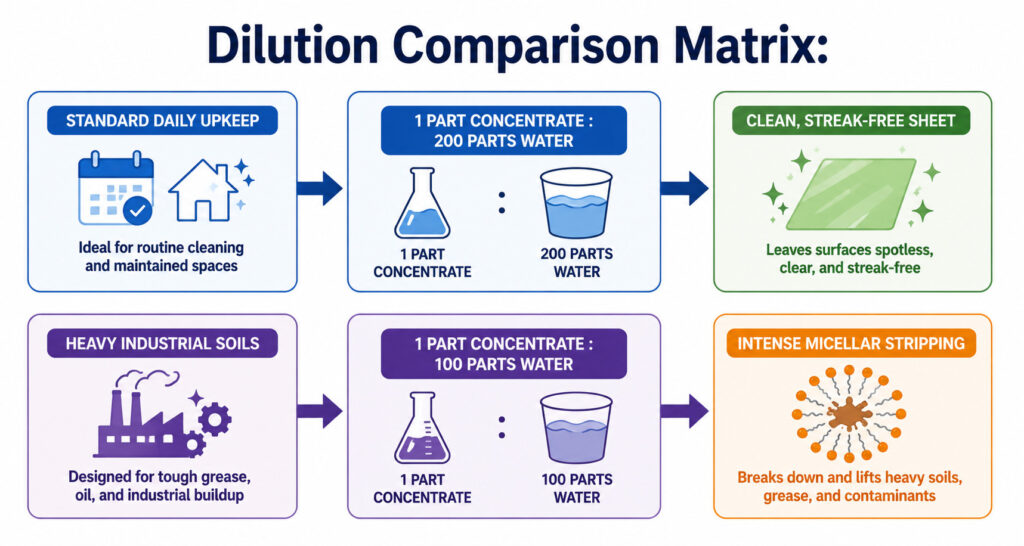
A proper bulk floor cleaner ratio guide relies on high-yield chemical dosing. For daily maintenance on non-porous or sealed surfaces, a premium concentrate operates at an ultra-lean ratio of 1:200 (approximately 1 to 2 ounces of fluid per 3 gallons of water). For heavy-duty post-construction cleanups or deep kitchen degreasing, the ratio tightens to 1:100.
Implementing a closed-loop automated dispensing pump system ensures an efficient mop bucket dilution every single shift. This precision saves thousands of liters of raw chemical stock across annual operations, bringing total predictability to your corporate purchasing cycle.
Managing Indoor Air Quality: Vapor Control in Commercial Spaces
Pungent post-cleaning odors and chemical fumes are a major source of friction in shared corporate spaces, healthcare facilities, and hotels. These aggressive smells are a direct result of rapid atmospheric changes as volatile liquid components turn into gas.
When janitorial crews adhere to the proper bulk floor cleaner ratio guide, the formulation’s evaporation rate mechanics function exactly as the laboratory chemists intended. The balanced fluid wets the substrate, encapsulates top-layer grime, and flashes off swiftly and evenly into the air column, leaving behind a subtle, fresh, and perfectly safe indoor environment.
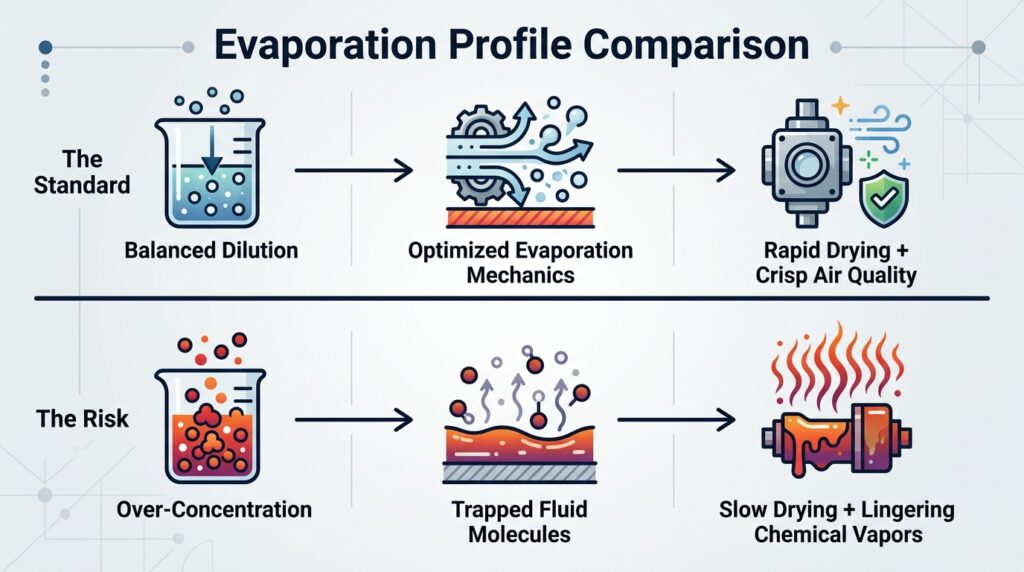
When floor soap is over-poured, the excess surfactant molecules trap moisture on the floor, dragging out the drying time. This stagnation forces an intense, extended off-gassing process, trapping heavy, volatile aromas in enclosed commercial spaces and causing sensory and respiratory irritation for building occupants. To look at our laboratory safety profiles, exact active density percentages, and diverse packaging options for our floor maintenance solutions, browse our full inventory at Boxy Klin.
The B2B Math: Shipping Active Matter, Not Water Volume
For international wholesalers, retail importers, and large-scale purchasing agents, the economics of floor care sourcing depend entirely on density. Buying pre-diluted, consumer-grade floor soaps means your business is paying heavy ocean freight and customs logistics costs to transport common water across international borders.
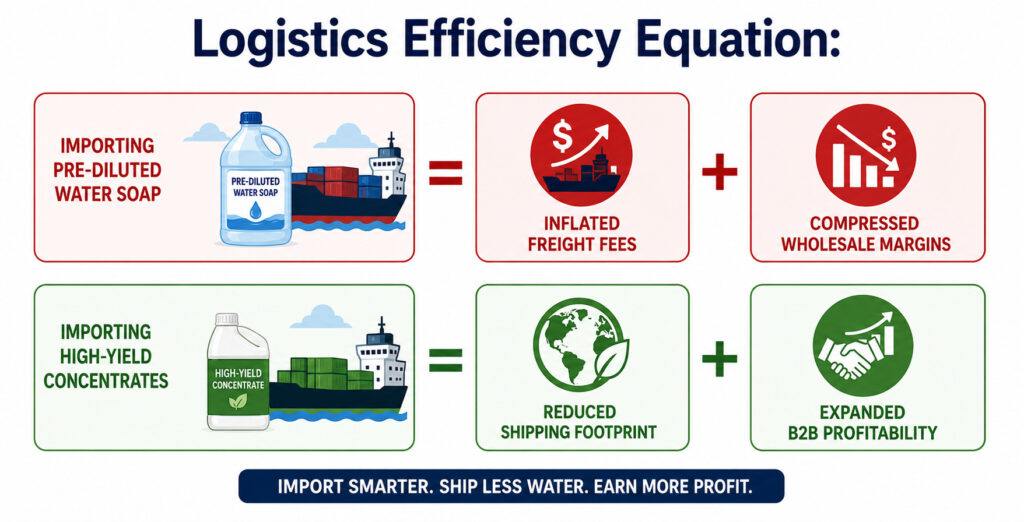
Investing in professional-grade, high-yield chemical dosing formulas means your supply chain imports pure, dense active matter. This chemical density drastically lowers your shipping footprint, reduces plastic packaging waste, and optimizes warehouse square footage. It provides distributors with an incredibly profitable, high-velocity product line that commercial clients will buy repeatedly due to its undeniable cost-per-wash value and operational longevity.
Future-Proofing Your Chemical Sourcing with Boxy Klin
Figuring out how much floor cleaner your teams should use isn’t a matter of guesswork; it is a precise chemical calculation. Sticking to a disciplined, efficient mop bucket dilution protects premium floor finishes from residual film accumulation, keeps indoor air crisp and breathable, and slashes product waste.
At Boxy Klin, we empower global distributors and private label brands by manufacturing high-yield, premium floor care concentrates that balance intense grease extraction with strict economic efficiency. To secure custom formulations tailored to your regional flooring trends or to obtain wholesale export pricing quotes, reach out to our West Java manufacturing plant directly at Boxy Klin.